
Loading...
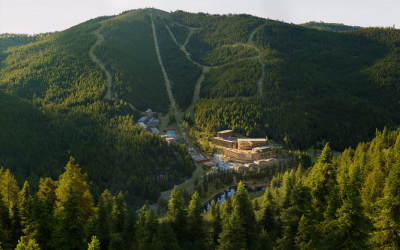
On August 15 in Slavsko, during the Eco Film Festival by Chysto.de, the GORO team presented its Responsible Development Model for a new mountain resort and participated in the open discussion “The Economics of Wilderness: How the Carpathians Can Develop Without Losing Their Identity.”
Eco Film Festival by Chysto.de is Ukraine’s first specialized international festival dedicated to ecology and cinema, organized by the environmental movement CHYSTO.DE. It serves as a platform for dialogue among conservationists, environmental organizations, activists, and experts working on the preservation of the Carpathians, biodiversity protection, waste management, and the responsible use of natural resources. Participants included Greenpeace Ukraine, Zero Waste Alliance Ukraine, the Ukrainian Nature Conservation Group, the Frankfurt Zoological Society, and other organizations. It was before this audience that GORO presented its Responsible Development Model and opened it up for discussion.
The GORO Responsible Development Model defines the principles that will guide the resort’s development over at least the next 15 years, covering everything from site selection, spatial planning, and architecture to forest restoration, engineering infrastructure, natural resource management, and local economic development. The model is built around five key pillars: organic mountain development, forest restoration, energy resilience, water and waste management, and value creation for local communities.
The resort’s core development principle is that nature must remain the defining element of the mountain destination. The GORO team is not seeking to create a “city in the mountains.” Instead, development and infrastructure are designed to integrate into the natural landscape while preserving guests’ sense of open space and connection to nature.
“For a project of this scale, a few environmental initiatives added after launch are simply not enough. GORO is being built from scratch, which gives us the opportunity to embed sustainability principles into the very logic of the resort from day one, in how we plan the territory, build infrastructure, manage natural resources and the environment, and engage with local communities. For us, it is essential that this remains a systematic approach throughout every stage of GORO’s development,” explains Rostyslav Mykhalchuk, Development Director of GORO Mountain Resort.
At GORO, this approach is summarized by the principle: “Preserve → Restore → Enhance.” It reflects a development model that combines care for the Carpathians’ natural assets with new opportunities for local businesses and communities. The resort is intended to stimulate entrepreneurship, create jobs, and generate demand for local goods and services, while strengthening the appeal of the Carpathians as a nature-based destination.
Before ski slope planning began, ILF Consulting Engineers (Austria) conducted a baseline environmental assessment of the area. Based on the findings, environmentally valuable zones were identified and excluded from areas designated for ski runs and other infrastructure. The resort’s overall building density is planned to remain below 25%, while the first development phase will occupy less than 10% of the total area. Architectural solutions emphasize minimal tree removal, terraced development, and integration into the natural landscape.
As part of the 15-year “Restoration of Forests and the Natural Heritage of the Carpathian Mountains” program, implemented jointly by GORO and Halsillis, the partners plan to restore 240 hectares of forest and plant approximately 1 million seedlings. This exceeds by more than three times the forest area required for ski slope development. The program has already begun, with 58,000 seedlings planted and approximately 15 hectares of forest restored.
GORO is developing its own energy infrastructure to reduce pressure on the power networks of the Slavsko community. Investments in new electricity infrastructure will amount to approximately €11 million and will include the construction of around 15 km of power lines with a capacity of 17.7 MW.
The resort will operate its own wastewater collection and treatment system, including water quality monitoring and a separate waste collection system with transfer to certified waste-management operators.
To support the snowmaking system, weekly river water level measurements were conducted over a five-year period. According to GORO’s calculations, water withdrawal will amount to approximately 0.5% of the river’s average daily flow and will occur for roughly 60 days per year. The water will then be stored in a reservoir at the mountain summit and used for snowmaking operations.
Tourism development should create value not only for the resort itself but also for the region in which it operates. For this reason, GORO considers the local economy an integral part of its development model through job creation, demand for locally produced goods and services, entrepreneurship support, and the development of local supply chains.
The objective is to ensure that a larger share of the economic value generated by tourism in the Carpathians remains within the region. According to GORO’s forecasts, the resort’s development is expected to create approximately 6,000 new jobs by 2030 and 25,000 jobs by 2039. The project is also expected to stimulate demand for local products and services, support entrepreneurship, and foster new supply chains.
To monitor and manage the resort’s environmental and social impacts, GORO applies several levels of assessment. Environmental Impact Assessments (EIA) are conducted for individual project components, while an international Environmental and Social Impact Assessment (ESIA) has already been completed for the resort as a whole. In addition, an ESG & Sustainability Strategy is currently being developed. The next stage will be the implementation of an environmental management system in accordance with ISO 14001 standards.
Both Ukrainian and international experts have been involved in assessing project impacts at different stages. The Institute of Ecology of the Carpathians of the National Academy of Sciences of Ukraine is evaluating biodiversity impacts, ILF Consulting Engineers (Austria) conducted surveys to define ski corridor routes, and Egis (France) carried out a strategic environmental and social impact analysis as part of the ESIA process.
GORO Mountain Resort is a year-round mountain resort being developed by OKKO Group in the Slavsko community of Lviv region, Ukraine. Total investment in the 1,200-hectare project over a 15-year period is estimated at approximately $1.5 billion.
The first development phase will include 10 ski slopes, a 100% artificial snowmaking system, one gondola lift, two chairlifts, and hospitality infrastructure. The opening of the first phase is scheduled for 2027.
 agency